
3.0 KiB
id, title, tags, daily
| id | title | tags | daily |
|---|---|---|---|
| 2026-05-19T12:23:11-0400 | 2026-05-19 12:23:11 | 2026-05-19 |
2026-05-19 12:23:11
Resistivity and Conductivity
In 2026-04-14_15-50-06 I described the relationship between the resistance and conductance...
Resistance and conductance are properties of electrical "objects" or "elements". Resistivity and conductivity are properties of materials.1
Resistivity is commonly represented by the Greek letter ρ (rho). The SI unit of electrical resistivity is the ohm-meter (Ω⋅m).
Electrical conductivity (or specific conductance) is the reciprocal of electrical resistivity. It represents a material's ability to conduct electric current. It is commonly signified by the Greek letter σ (sigma), but κ (kappa) (especially in electrical engineering) and γ (gamma) are sometimes used. The SI unit of electrical conductivity is siemens per meter (S/m).
The meaning of these units are not intuitive, but are better understood from the ideal case diagrammed below:
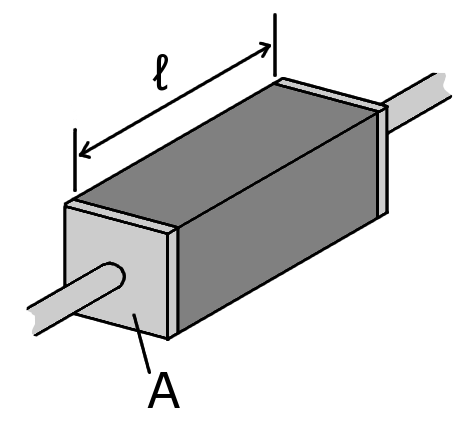
The resistance of the conductor
is directly proportional to its length \ell,
and inversely proportional to its cross-sectional area A.
R \propto {\frac{\ell}{A}}
Let electrical resistivity \rho be the constant of proportionality.
R = \rho \frac{\ell}{A}
(This equation is known as Pouillet's law, after Claude Pouillet)
\Leftrightarrow \rho = R \frac{A}{\ell},
where
Ris the electrical resistance of a uniform specimen of the material\ellis the length of the specimenAis the cross-sectional area of the specimen
The meaning of the ohm-meter (Ω⋅m) in this context is difficult to grok. Wikipedia describes it thus:
...ohms multiplied by square meters (for the cross-sectional area) then divided by meters (for the length).
%%
The conductance of the conductor
is inversely proportional to its length \ell,
and directly proportional to its cross-sectional area A.
G \propto {\frac{A}{\ell}}
Let electrical conductivity \sigma be the constant of proportionality.
\begin{aligned}
R &= \sigma \frac{A}{\ell} \\
\Leftrightarrow \sigma &= G \frac{\ell}{A},
\end{aligned}
where
Gis the electrical resistance of a uniform specimen of the material\ellis the length of the specimenAis the cross-sectional area of the specimen
%%
Conductivity, \sigma, is the inverse of resistivity:
\sigma = \frac{1}{\rho}
-
It would be more accurate to describe this relationship in terms of intensive and extensive properties. The resistance and conductance of a copper bar would not change if the cube doubled in size, but its resistivity and conductivity ↩︎