
105 lines
3.0 KiB
Markdown
105 lines
3.0 KiB
Markdown
---
|
||
id: 2026-05-19T12:23:11-0400
|
||
title: 2026-05-19 12:23:11
|
||
tags: []
|
||
daily: "[[2026-05-19]]"
|
||
---
|
||
# 2026-05-19 12:23:11
|
||
|
||
## Resistivity and Conductivity
|
||
|
||
In [[2026-04-14_15-50-06]] I described the relationship
|
||
between the resistance and conductance...
|
||
|
||
[**Resistance** and **conductance**](https://en.wikipedia.org/wiki/Electrical_resistance_and_conductance)
|
||
are properties of electrical "objects" or "elements".
|
||
[**Resistivity** and **conductivity**](https://en.wikipedia.org/wiki/Electrical_resistivity_and_conductivity) are properties of **materials**.[^1]
|
||
|
||
[^1]: It would be more accurate to describe this relationship
|
||
in terms of [intensive and extensive properties](https://en.wikipedia.org/wiki/Intensive_and_extensive_properties).
|
||
The resistance and conductance of a copper bar
|
||
would not change if the cube doubled in size,
|
||
but its resistivity and conductivity
|
||
|
||
> Resistivity is commonly represented by the Greek letter ρ (rho).
|
||
> The SI unit of electrical resistivity is the ohm-meter (Ω⋅m).
|
||
|
||
> Electrical conductivity (or specific conductance)
|
||
> is the reciprocal of electrical resistivity.
|
||
> It represents a material's ability to conduct electric current.
|
||
> It is commonly signified by the Greek letter σ (sigma),
|
||
> but κ (kappa) (especially in electrical engineering) and γ (gamma)
|
||
> are sometimes used.
|
||
> The SI unit of electrical conductivity is siemens per meter (S/m).
|
||
|
||
The meaning of these units are not intuitive,
|
||
but are better understood from the ideal case
|
||
diagrammed below:
|
||
|
||
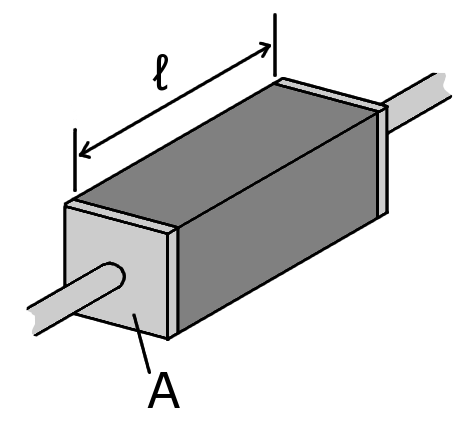
|
||
|
||
The **resistance** of the conductor
|
||
is directly proportional to its length $\ell$,
|
||
and inversely proportional to its cross-sectional area $A$.
|
||
|
||
$$
|
||
R \propto {\frac{\ell}{A}}
|
||
$$
|
||
|
||
Let electrical resistivity $\rho$ be the constant of proportionality.
|
||
|
||
$$
|
||
R = \rho \frac{\ell}{A}
|
||
$$
|
||
|
||
(This equation is known as **Pouillet's law**,
|
||
after [Claude Pouillet](https://en.wikipedia.org/wiki/Claude_Pouillet))
|
||
|
||
$$
|
||
\Leftrightarrow \rho = R \frac{A}{\ell},
|
||
$$
|
||
|
||
where
|
||
|
||
* $R$ is the electrical resistance of a uniform specimen of the material
|
||
* $\ell$ is the length of the specimen
|
||
* $A$ is the cross-sectional area of the specimen
|
||
|
||
The meaning of the ohm-meter (Ω⋅m) in this context is difficult to grok.
|
||
Wikipedia describes it thus:
|
||
|
||
> ...ohms multiplied by square meters (for the cross-sectional area)
|
||
> then divided by meters (for the length).
|
||
|
||
%%
|
||
|
||
The **conductance** of the conductor
|
||
is _inversely_ proportional to its length $\ell$,
|
||
and _directly_ proportional to its cross-sectional area $A$.
|
||
|
||
$$
|
||
G \propto {\frac{A}{\ell}}
|
||
$$
|
||
|
||
Let electrical conductivity $\sigma$ be the constant of proportionality.
|
||
|
||
$$
|
||
\begin{aligned}
|
||
R &= \sigma \frac{A}{\ell} \\
|
||
\Leftrightarrow \sigma &= G \frac{\ell}{A},
|
||
\end{aligned}
|
||
$$
|
||
|
||
where
|
||
|
||
* $G$ is the electrical resistance of a uniform specimen of the material
|
||
* $\ell$ is the length of the specimen
|
||
* $A$ is the cross-sectional area of the specimen
|
||
|
||
%%
|
||
|
||
Conductivity, $\sigma$, is the inverse of resistivity:
|
||
|
||
$$
|
||
\sigma = \frac{1}{\rho}
|
||
$$ |